
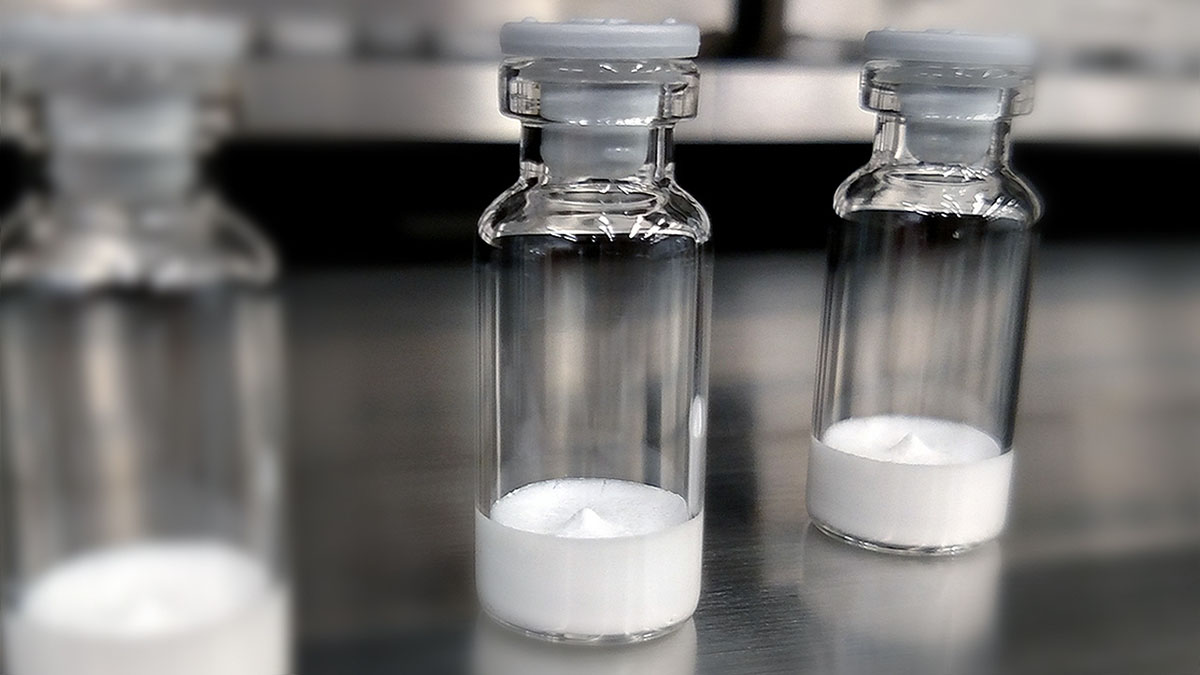
Retatrutide is commonly supplied in lyophilized (freeze-dried) form for research purposes. Before it can used, the material must be reconstituted into a solution.
Retatrutide (also known by its code name LY3437943 or nickname “triple G” drug) is a medication that acts as a triple-hormone-receptor agonist, targeting the body’s receptors for GIP (glucose-dependent insulinotropic polypeptide), GLP-1 (glucagon-like peptide-1), and glucagon. It is considered by many to be the strongest of all GLP-like drugs due to its effects on all receptors.
Shortcut: The standard for reconstituting GLP/GIP drugs is generally 1ml of liquid per 10mg of peptide. This is used for simplicity as it translates well to IU’s: 1ml is equal to 100 IU’s on a syringe. Thus, 3.5mg of peptide works out to 0.35ml’s, and 35 IU’s. For more precise dosage instrustions please check out our Peptide Dosage Calculator.
While reconstitution is often treated as a routine laboratory task, outcomes vary widely in practice. Differences in material quality, handling conditions, and reconstitution technique can all influence solubility, stability, and reproducibility. For this reason, reconstitution is not merely a procedural step—it is an important quality checkpoint.
This article examines how lyophilized retatrutide is typically reconstituted in laboratory settings, with emphasis on process considerations, common failure points, and quality-control implications.
Why is Retatrutide Is Supplied as Lyophilized Powder?
Lyophilization is used to improve stability and shelf life by removing moisture from the peptide matrix. For compounds like retatrutide, this format reduces degradation during storage and transport, but it also places greater importance on controlled reconstitution.
Variability introduced at this stage can obscure true material quality and lead to inconsistent experimental results.
What are the most common, safe liquids used for reconstitution?
1️⃣ Bacteriostatic Water
Bacteriostatic water is purified water that contains a low-concentration antimicrobial preservative designed to inhibit bacterial growth after the container has been accessed.
Why it’s used:
- Helps maintain sterility in multi dose vials.
- Reduces risk of microbial growth when a vial is entered multiple times.
Limitations
- Does not prevent chemical or structural degradation of peptides.
- Preservatives may be unsuitable for certain applications or sensitivities.
- Still requires proper storage and handling.
2️⃣ Purified/Distilled Water
Why it’s used:
- Simple, pH-neutral solvent.
- No added preservatives or chemicals.
- Often used when single-use preparation is intended.
Limitations
- No protection against microbial growth once opened
- Unsuitable for multi-dose use unless handled under sterile conditions
- Shorter practical usability after reconstitution
3️⃣ Saline Solutions
Why It’s used:
- Osmotically balanced compared to pure water.
- Commonly available in sterile, injectable form.
- Can be preferred when isotonic conditions are required.
Limitations
- No antimicrobial preservatives.
- Ionic content may affect stability of certain compounds.
- Not universally appropriate for all peptide formulations.
Common Issues Observed During Reconstitution
Across independent evaluations and laboratory observations, several issues appear repeatedly:
Incomplete dissolution
Residual particulates or cloudiness may indicate formulation inconsistencies, degradation, or handling errors.
Mechanical stress sensitivity
Excessive agitation or rapid handling can compromise peptide integrity, particularly for lower-quality material.
Moisture exposure
Improper storage prior to reconstitution can introduce variability that only becomes apparent once the material is in solution.
Misinterpretation of appearance
Visual clarity alone does not guarantee successful reconstitution or material purity.
These issues are often incorrectly attributed to technique when underlying material quality is the real driver.
Quality-Control Implications
Reconstitution is one of the first stages at which quality differences between suppliers become observable. Materials that appear comparable on paper—based on a Certificate of Analysis alone—may behave very differently once reconstituted.
For this reason:
This is why Peptide Score places emphasis on independent testing, repeat sampling, and transparency, rather than isolated documentation.
Supplier Quality and Reconstitution Outcomes
Inconsistent reconstitution behavior is frequently correlated with:
When evaluating suppliers, reconstitution performance should be considered a downstream signal of upstream quality practices—not merely a procedural variable.


Retatrutide is the King of GLP-1’s!